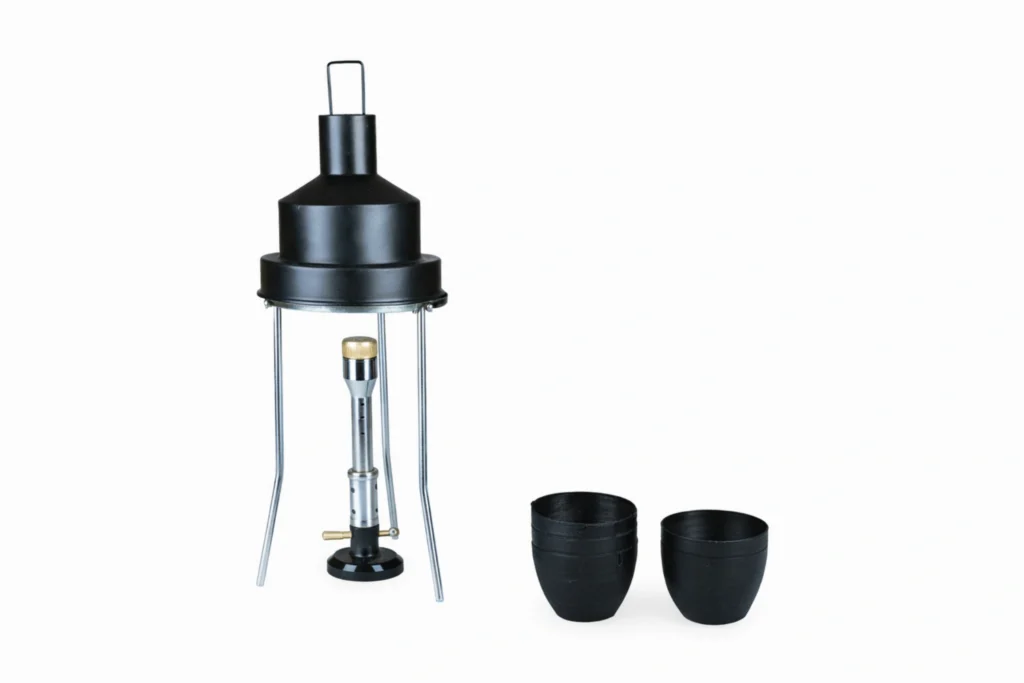
Conradson Carbon Residue Apparatus
Conradson Carbon Residue Apparatus
MT-CR210
The Conradson Carbon Residue Apparatus is designed for determining the carbon residue of petroleum products using the traditional Conradson method. The instrument is manufactured in accordance with GB/T 268 – Test Method for Carbon Residue of Petroleum Products (Conradson Method) and corresponds to ASTM D189.
Introduction
Carbon residue is an important parameter used to evaluate the coking tendency of petroleum products during thermal decomposition. The test measures the amount of carbonaceous residue remaining after evaporation and pyrolysis of the sample under specified conditions.
In this method, the sample is heated using a gas flame heating system in a set of nested crucibles. The volatile components are evaporated, and the remaining material undergoes thermal decomposition to form carbon residue. The final residue is used to assess the tendency of fuels and oils to form deposits during high-temperature operation.
This Conradson Carbon Residue Apparatus features a simple structure, complete accessory configuration, and easy operation, making it suitable for laboratories that require a traditional and cost-effective carbon residue testing solution.
It is widely used in petroleum laboratories, fuel testing facilities, research institutes, and educational institutions.
Typical Applications
The Conradson Carbon Residue Apparatus is used to determine the carbon residue content of petroleum products.
- Lubricating oils
- Heavy fuel oils
- Residual oils
- Petroleum distillation residues
- Heavy petroleum products
Typical application environments include:
- Petroleum refineries
- Petrochemical plants
- Fuel testing laboratories
- Research institutes
- Universities and training laboratories
Key Features
1. Standard Conradson Test Method
The instrument fully complies with the GB/T 268 and ASTM D189 standard method, ensuring reliable and comparable test results.
2. Gas Flame Heating System
The apparatus uses a gas burner heating method, simulating traditional carbon residue testing conditions.
3. Complete Test Assembly
The instrument includes a full set of crucibles, support frame, flame shield, and accessories, allowing immediate operation after installation.
4. Simple and Practical Design
The system features a compact and straightforward structure, making it easy to operate and maintain.
5. Flexible Fuel Source
The apparatus can be operated using domestic gas, natural gas, or other common fuel gases, offering flexibility in laboratory environments.
Technical Specifications
|
Name |
MT-CR210 Conradson Carbon Residue Apparatus |
|
Porcelain Crucible |
Low form, approx. 30 mL |
|
Inner Iron Crucible |
75 ± 5 mL, black-coated |
|
Outer Iron Crucible |
190 ± 10 mL, with lid, black-coated |
|
Tripod Stand |
Height 250 ± 10 mm, ring diameter 130 ± 5 mm |
|
Flame Shield |
Steel plate (0.6–0.8 mm), with asbestos ring |
|
Optional Shield Design |
Three support legs for direct crucible placement |
|
Iron Hood |
Steel plate (0.8 mm), with flame height indicator |
|
Burner Type |
Meker-type gas burner |
|
Heating Method |
Gas flame heating |
Standards Compliance
This Conradson Carbon Residue Apparatus complies with:
- ASTM D189 – Standard Test Method for Conradson Carbon Residue of Petroleum Products
- GB/T 268 – Test Method for Carbon Residue of Petroleum Products (Conradson Method)
These standards are widely used for evaluating the coking tendency of petroleum products and heavy oils.
Why Choose Our Conradson Carbon Residue Apparatus
Standard-Compliant Traditional Testing
Fully meets ASTM D189 and GB/T 268 requirements for carbon residue determination.
Cost-Effective Laboratory Solution
Simple structure and gas heating system provide an economical testing solution.
Complete Accessory Configuration
Supplied with all necessary components for immediate laboratory use.
Flexible Operation
Compatible with various gas sources, making it suitable for different laboratory environments.
Ideal for Teaching and Routine Testing
Widely used in educational laboratories and routine petroleum testing applications.