
Interfacial Tension Tester
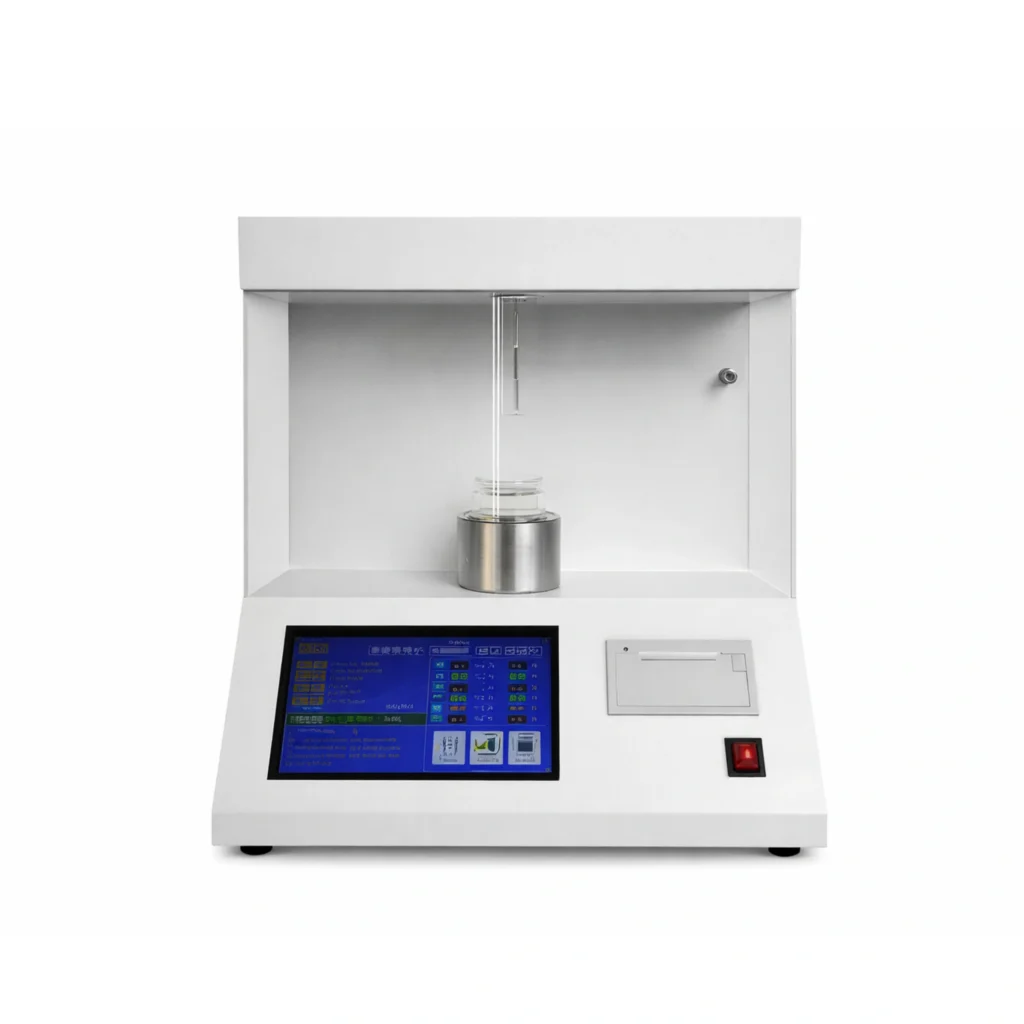
Interfacial Tension vs Surface Tension in Insulating Oil Testing
|
Comparison Item |
Interfacial Tension (IFT) |
Surface Tension |
|
Definition |
Force at the interface between two immiscible liquids, typically oil and water |
Force at the interface between a liquid and air |
|
Interface Measured |
Oil–water interface |
Liquid–air interface |
|
Application in Oil Testing |
Standard parameter for insulating oil and transformer oil condition assessment |
General physical property, not specific to insulating oil analysis |
|
Sensitivity to Oil Aging |
Highly sensitive to polar contaminants, oxidation products, and oil degradation |
Limited relevance to oil aging and contamination |
|
Industry Usage |
Widely used in power, energy, and laboratory oil analysis |
Commonly used in general chemistry and material science |
|
International Standards |
ASTM D971, ISO 6295 |
Not defined as a standard test for transformer oil |
|
Accuracy for Transformer Oil |
Technically accurate and recommended √ |
Not technically precise for insulating oil testing × |
|
Typical Terminology in Practice |
Often abbreviated as IFT |
Sometimes used informally in search queries |
Applications of Interfacial Tension Tester
Our interfacial tension testers are widely used in:
· Condition assessment of transformer insulating oils
· Monitoring oil aging and oxidation levels
· Preventive maintenance for power transmission equipment
· Quality control of new and reclaimed insulating oils
Key Interfacial Tension Testing Parameters
· Why Interfacial Tension Matters for Insulating Oils
Interfacial tension testing plays a key role in evaluating the health of insulating oils. A decreasing interfacial tension value indicates the accumulation of polar contaminants, oxidation products, and aging compounds. By monitoring interfacial tension, maintenance teams can detect oil degradation early and make informed decisions regarding oil treatment or replacement.
· Test Standards Compliance
Supports international standards such as ASTM D971, ISO 6295, and related methods.
· Test Repeatability & Accuracy
Ensures consistent and reliable titration results through automated titration control and precise endpoint detection.
Related Testers
- Dielectric Breakdown Voltage Testers (BDV)
- Moisture Analyzers
- Acidity Testers
- Dissolved Gas Chromatograph (DGA)
- Interfacial Tension Testers
- Dielectric Loss & Volume Resistivity Tester
- More
- Kinematic Viscosity Testers
- Density Testers
- Flash Point Testers
- Wear Abrasion Testers
- Particle Contamination Testers
- Oxidation Stability Testers
- Copper Corrosion Testers
- Foaming Characteristics Testers
- Air Release Value Testers
- More
- Pour Point/Cloud Point /Freezing Point Testers
- Sulfur Content Testers
- Distillation (Boiling Range) Testers
- Demulsibility Testers
- Ash Content Testers
- Aniline Point Testers
- Carbon Residue Testers
- Foaming Characteristics Testers
- Air Release Value Testers
- More




Contact Us for Interfacial Tension Testing Solutions
Need an Interfacial Tension Tester for Your Application?
Contact us to learn more about our interfacial tension testing solutions or to request technical support for insulating oil analysis.